
The quarter after your Series B closes, the roadmap triples and your platform stays exactly the same size. That is the moment development for scale-ups stops being a hiring question and becomes an engineering problem. We have watched senior engineers spend entire sprints unblocking others while release frequency quietly drops from weekly to monthly. The incident channel gets louder. Nobody is doing anything wrong, and yet everything is slower. Below, we unpack where growth stage delivery actually breaks, compare the realistic engagement models side by side, and give you a one-month plan for tightening the delivery system itself.
Reading time: 12 min
Key points
- Scale-ups fail during transitions, not steady state, and the constraint is usually the delivery system, not the people.
- Scale the system of delivery, including branch strategy, CI gates and ownership boundaries, before scaling the team.
- Staff augmentation adds hands inside a mature system; a dedicated pod with shared standards is the stronger model for end-to-end delivery.
- One focused month on metrics, CI reliability, review policy and ownership can move your constraint from chaos to something nameable.
Table of contents
When the roadmap outruns the platform
Development for scale-ups is the shift from proving a product to reliably shipping at higher volume without breaking quality, security, or uptime. A growth stage company hits this inflection when the roadmap expands, systems become interconnected, and coordination costs rise faster than headcount. Adding a fifth engineer makes things faster. Adding a fifteenth makes every change a negotiation.
The trap is that the platform is still startup-grade while expectations are not. The monolith that survived ten users a day now carries enterprise traffic. The deploy script that one person knows by heart is now the only path to production.
The OECD Digital Economy Outlook 2024 documents how rapidly digital transformation pressures are compounding across economies, and engineering organizations feel that compression first. Senior engineers spend more time unblocking than building. Incident load rises. Release frequency drops. Those three signals together mean your delivery system, not your people, is the constraint.
Why adding engineers slows you down first
Every new engineer adds communication paths, review load, and integration work. Throughput falls before it rises. The two-week onboarding promise assumes a clean codebase, and no scale-up has one. A real repository carries years of legacy decisions, partial test coverage, and tribal conventions that exist nowhere except in the heads of three people.
The hidden work drains you quietly. Code review queues grow. CI becomes flaky because ten teams now share one pipeline. Environment parity breaks, and QA triage eats an afternoon every day. None of this shows up in a headcount plan.
Scale the system of delivery before you scale the team. Branch strategy, CI gates, and ownership boundaries first. We have written separately about scaling up tech teams quickly without compromising quality, and the pattern holds everywhere. Scaling technology and scaling engineering are two different projects, and doing them in the wrong order is expensive.
Where scale-ups actually break
Scale-ups fail during transitions, not during steady state. The dangerous moments are when key knowledge is concentrated in one or two people and the system is changing under load. That combination is where development for scale-ups goes wrong.
Picture a database migration scheduled for the same quarter as peak feature pressure. Then the engineer who owns the schema hands in their resignation. There is no written migration plan, no staged rollout, no feature flag to hide the change behind, and no directly responsible individual for the cross-service coordination. The migration slips. Then it slips again. Then someone attempts it at 2 a.m. and takes the checkout flow down with it.
Expansion support at this stage means making transitions safe, not making them fast. Document the decision. Stage the rollout. Name an owner. A brittle deploy step with no rollback procedure is a transition waiting to fail, and transitions are where growth stage companies lose quarters.
Ownership boundaries that let parallel work happen
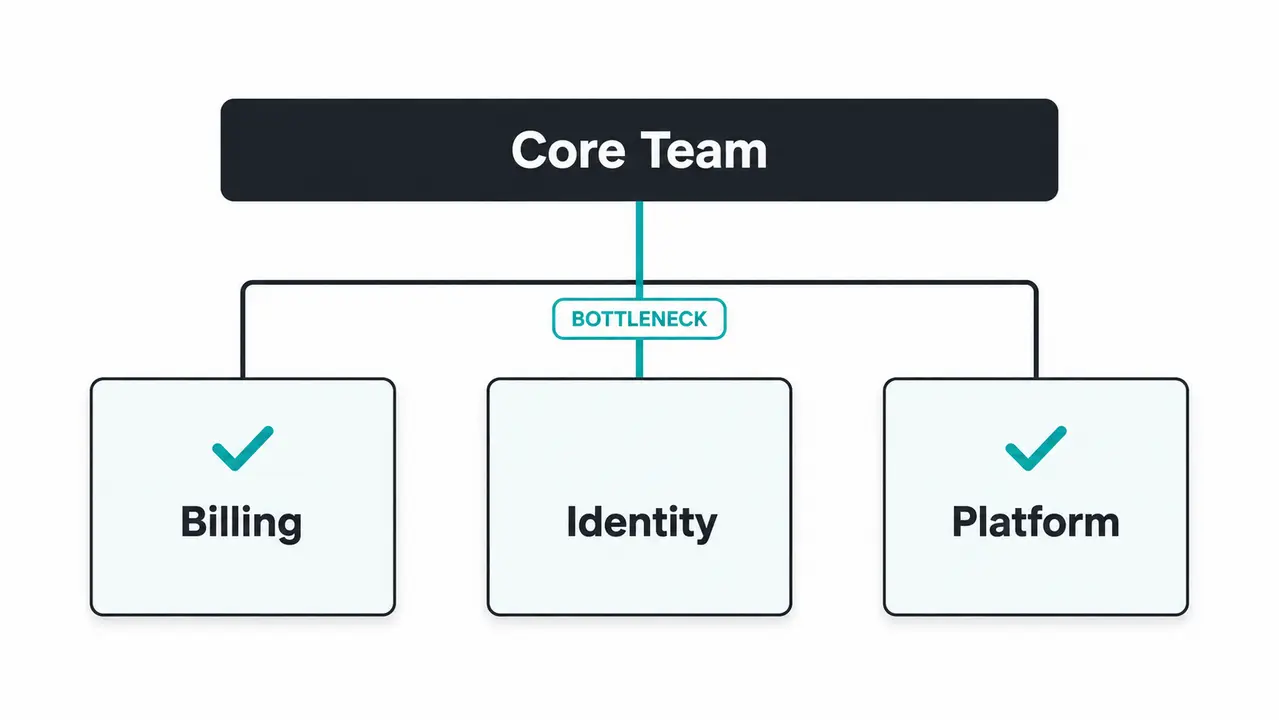
Clear ownership boundaries reduce coordination overhead and make parallel work safe. Without them, every team negotiates with every other team before shipping anything. The common scale-up trap is a single core team that becomes the dependency for every change, from a new payment flow to a copy fix on the marketing site.
Ownership can be drawn along several lines. By domain, such as billing or identity. By service. By customer journey, like onboarding versus retention. By platform layer, such as frontend, API, and data. The line matters less than the fact that it exists and someone can name it.
Without a service catalog, an ownership map, and interface contracts between teams, everything bottlenecks at the core team and product development stalls. With them, three teams ship independently on the same product. If you want to see how this plays out in practice, our product development work starts from exactly this map, because a growth stage company cannot parallelize what it has not divided.
When a rebuild is justified and when it is not
A rebuild is justified when the cost of change is compounding and refactors cannot restore predictability within a few release cycles. A refactor is enough when problems are localized and you can stabilize interfaces without a full rewrite. Most teams reach for the rebuild too early and regret it.
The decision signals are specific. Regression rate stays high even after targeted fixes. Estimation becomes impossible because every ticket uncovers hidden coupling. Incidents repeatedly trace back to the same subsystem. When two of those three are true, scaling technology means confronting the rewrite question honestly.
The deliverable is short. A technical RFC, three to five pages, stating scope, success metrics, migration strategy, and rollback plan. If nobody can write that document, the rebuild is not ready to start. Development for scale-ups fails most often when a rewrite begins as a reaction rather than a decision.
The pain is operability, not throughput
Most scale-up pain involves reliability and operability, not raw throughput. Deploy safety, observability, and incident response. Flaky CI that fails randomly and gets re-run on instinct. Missing metrics, so every incident starts with twenty minutes of guessing. Noisy alerts that everyone ignores. Manual deploy steps that only one person remembers.
Fix the fundamentals. Set SLOs for your key user journeys, starting with checkout and login. Define error budgets and treat them as real limits on feature work. Add structured logging and tracing for critical flows so triage takes minutes instead of hours.
Reliability work needs explicit capacity allocation, or feature pressure will push it aside every sprint until a major outage makes the decision for you. The Secure Software Development Framework practices in NIST SP 800-218 are a useful baseline for standardizing secure deployment and reducing vulnerabilities, and they slot cleanly into existing CI gates. Expansion support that ignores operability is not expansion. It is deferred downtime.
Review queues that turn engineering into batch processing
Long review queues turn continuous delivery into batch processing. A pull request that sits for three days accumulates merge conflicts, stale context, and a growing diff, which makes review harder, which makes the queue longer. The second-order effects are the real cost. Larger pull requests. More defects escaping to staging. Engineers context-switching because their work is blocked.
Set PR size limits, around 400 lines as a working rule. Put code ownership rules in the repository so the right reviewers are assigned automatically. Set a review SLA, even a loose one like same-day for small changes. Pair on risky changes instead of reviewing them after the fact.
Automate everything trivial. Lint and formatting checks in GitHub Actions remove the comments nobody should be writing anyway, and they keep review attention on architecture. Scaling engineering is mostly about protecting the feedback loop, and the feedback loop lives or dies in the review queue.
Onboarding is a shared mental model, not repo access
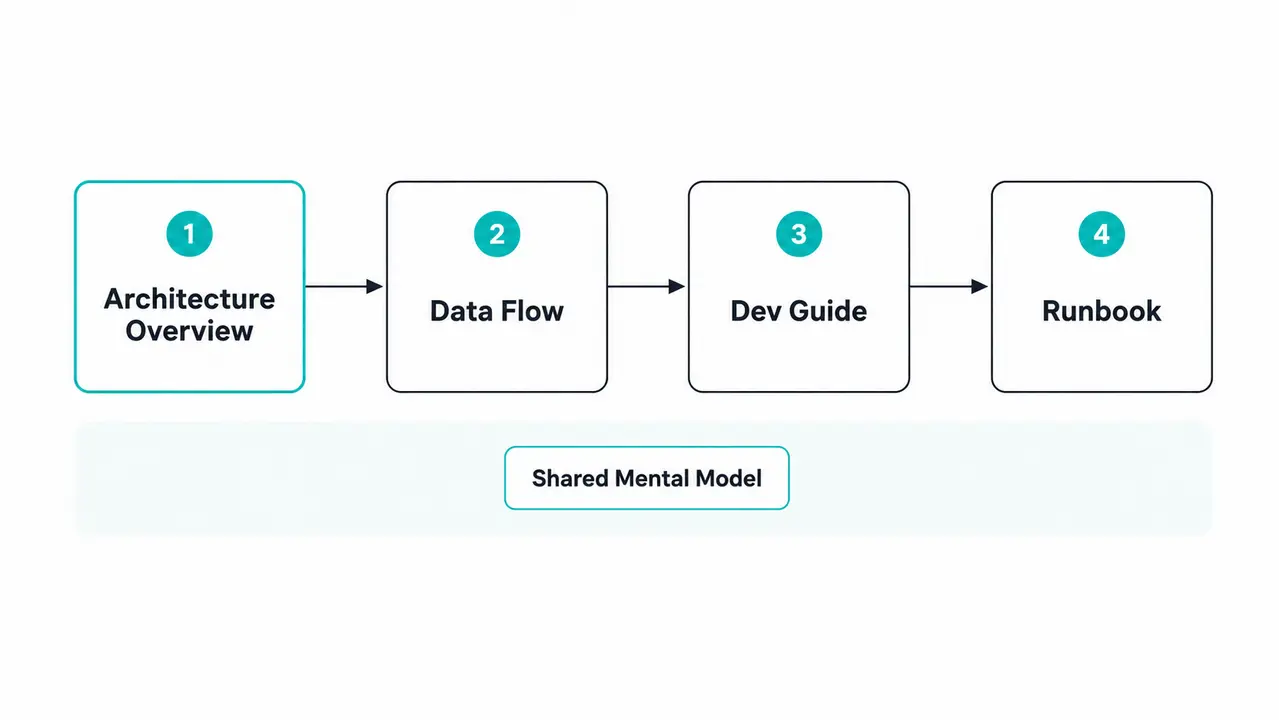
Scale-up onboarding requires a shared mental model of the system, not a laptop, repo access, and a task list. A growth stage company that onboards with credentials alone is paying full salary for two months of partial productivity.
The artifacts that create narrative are few and cheap. An architecture overview, even a diagram on one page. A data flow diagram. A local dev guide that actually works on a fresh machine. A runbook for the three most common incidents. Write them once and they pay for themselves with every hire.
A practical onboarding sprint beats a syllabus. One small feature shipped end to end. One bug fix that forces a code read. One on-call shadow shift. One documentation improvement, because the new hire is the only person who can see which docs are wrong. Role-based tracks matter too. A senior IC needs architecture context and decision history. A mid-level engineer needs the dev guide and pairing time. QA and DevOps need environments and pipelines, not a generic week one. Without this, expansion support becomes a six-month ramp.
Tests that protect speed instead of slowing it down
Scale-ups need tests that protect speed. Fast feedback, stable environments, and coverage concentrated on business-critical flows. Coverage percentage is the wrong target. A suite at 85 percent that misses the payment path is worse than a suite at 60 percent that protects it.
Prioritize by failure cost. Contract tests at service boundaries, so teams can refactor independently. Integration tests for the workflows that generate revenue. Unit tests for genuinely complex logic, like pricing rules and permission checks. That is the shape of a suite that lets scaling technology happen without fear.
The anti-pattern is the brittle UI-only suite. Slow end-to-end tests requiring manual data setup, failing on timing issues, re-run twice before anyone trusts the result. A CI pipeline that takes hours forces engineers to context-switch, and every switch costs the focus that high velocity depends on. Development for scale-ups lives or dies on the speed of the feedback loop.
Shipping is a system you have to design
At the scale-up stage, shipping is a system that needs design. Environments, deployment patterns, rollback discipline. Early-stage teams can deploy by hand on a Friday and survive. Scale-ups pay for that habit in incidents and downtime, usually within two quarters of growth.
The toolkit is known. Feature flags so incomplete work ships dark. Canary releases and blue-green deploys so a bad version reaches five percent of users instead of all of them. Progressive delivery so rollout speed becomes a dial rather than a gamble. Schema migration patterns like expand and contract, so the database never has to stop for the application.
The operational documents matter as much as the tooling. A release checklist. A rollback playbook that someone has actually executed once, in daylight, on purpose. A definition of done that includes telemetry and alerting, not just merged code. Expansion support that skips these artifacts delivers features and inherits incidents.
How an embedded team model actually works
An embedded team model succeeds when you own product direction and technical standards while the external team integrates into your rituals. Not a parallel process. The same backlog, the same repositories, identical code review rules, the same sprint cadence. From the outside, there should be no visible seam between your engineers and theirs.
The governance model is simple. One tech lead on your side sets the guardrails, architectural decisions, quality bars, priorities. The external team brings execution capacity plus senior delivery leadership so the day-to-day does not depend on your lead unblocking people.
The failure mode is quiet dependency. Without a knowledge transfer plan, documentation expectations written into the engagement, and pairing rotations between the two groups, you build a permanent external dependency dressed up as a partnership. Others simply supply developers. We become part of your company, and the difference shows up eighteen months later in who understands the system.
Hiring in-house and what it can and cannot fix
Hiring alone rarely matches the speed of roadmap expansion. Recruiting, onboarding, and team formation all lag behind delivery needs by months, while the roadmap pressure exists today. A growth stage company that plans to hire its way out of a delivery bottleneck is planning to be slow for two more quarters.
The real constraints are rarely discussed. Interview bandwidth, because your senior engineers are already the bottleneck and now they spend Fridays in loops. Senior mentorship capacity, because every new hire needs it. Team cohesion, because five hires in one quarter changes how the existing team communicates. Attrition risk, because a team stretched thin is a team interviewing elsewhere.
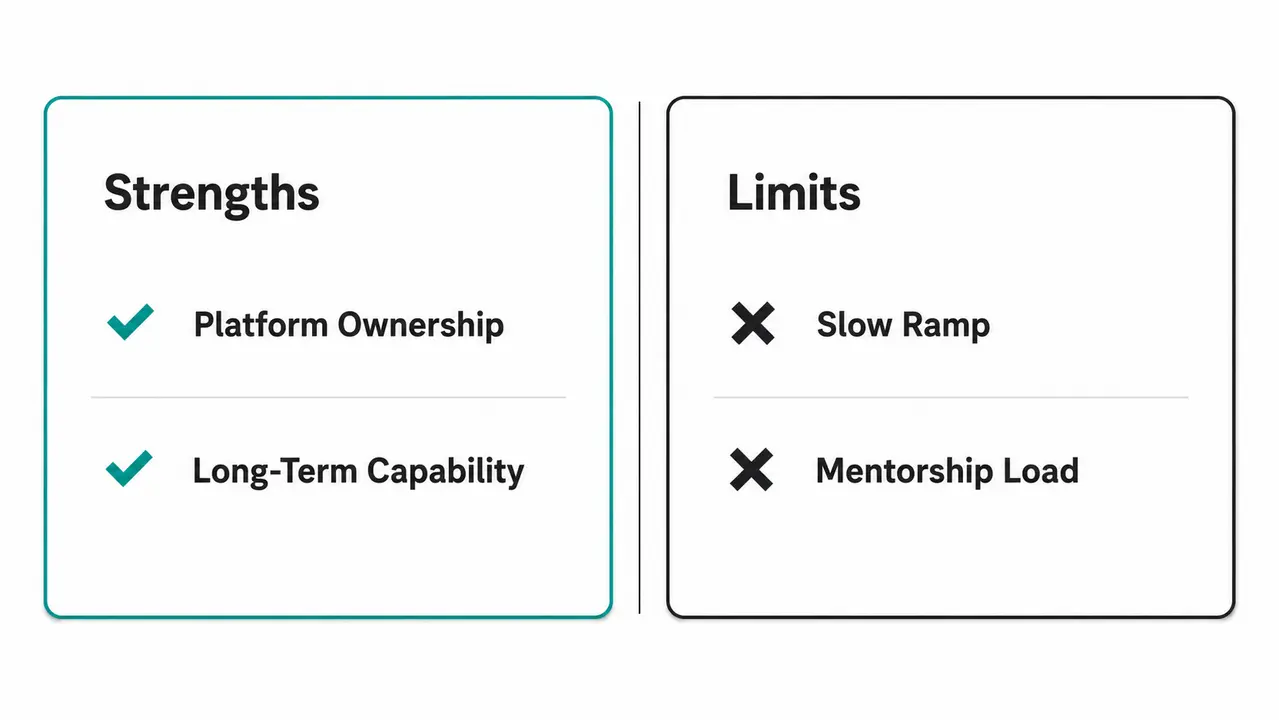
Hiring is the right move for core platform ownership, long-term differentiation, and security-sensitive domains. It is weaker for short-term capacity recovery and stronger for long-horizon capability building, provided leadership bandwidth exists to absorb the formation cost. Scaling engineering through hiring is a strategy. It is just a slow one, and pretending otherwise wastes the quarter you needed it to save.
Why staff augmentation disappoints and what fixes it
Staff augmentation underperforms when individuals are added without a coherent operating model. The traditional definition, where external personnel take day-to-day direction from the client, describes exactly why it struggles at scale. You get ticket takers instead of engineers. Code quality varies by individual. Context fragments across people who never talk to each other. Your review burden goes up, not down.
The fix is structural. Pod-based delivery instead of isolated individuals. Defined outcomes instead of open-ended capacity. Shared standards enforced through the same CI gates and review rules your team uses. One accountable lead per workstream, so quality has an owner.
Our verdict is blunt. Staff augmentation is weaker for end-to-end delivery and system-level thinking, and workable only for well-scoped tasks inside a mature engineering system. If your system is already mature, augmentation adds hands. If it is not, augmentation adds problems.
The dedicated pod as a delivery unit
A dedicated pod is a stable, cross-functional unit that owns a slice of the product and ships continuously. Stable is the operative word. A pod that stays together for a year accumulates domain knowledge that no amount of documentation can replace, and fewer handoffs mean predictable velocity.
A workable composition looks like this. A tech lead, two to four engineers, QA, DevOps support, and a product counterpart on your side. Small enough to coordinate in one standup. Complete enough to ship without asking another team for permission.
This is the model behind our dedicated software engineering teams, and the reason we defend pod stability so hard. The model is weaker when you cannot provide product ownership on your side, because a pod without direction builds the wrong thing quickly. It is strongest when a scale-up needs reliable throughput on a defined domain, which is most scale-ups, most of the time.
Let’s scope your team
If your roadmap has outrun your platform, a short conversation about the constraint you are protecting is the fastest next step.
Choosing the model by constraint, not by habit
The best engagement model depends on what is actually constraining you. Speed, leadership bandwidth, or architectural risk. Teams pick models by habit or by procurement preference, and then wonder why the bottleneck moved rather than disappeared.
This comparison covers the three realistic options for a growth stage company.
| Dimension | In-house hiring | Staff augmentation | Dedicated pod |
|---|---|---|---|
| Time to start | Months | Weeks | Weeks |
| Onboarding load on your team | High | High and ongoing | Low after ramp |
| Quality control | Full control | Varies by individual | Shared standards from day one |
| Knowledge retention | Strongest | Weakest | Strong with transfer plan |
| Ownership clarity | Clear | Often unclear | Defined per domain |
| Risk of dependency | Not applicable | High | Managed by design |
Use decision rules, not preferences. Lead time exploding means choose stability and ownership. Architecture is the risk means prioritize senior technical guidance over raw capacity. Scaling engineering is a sequence of choices, and a stable team with clear ownership beats a rotating pool in almost every scenario where continuity matters.
Planning the platform transition as a program
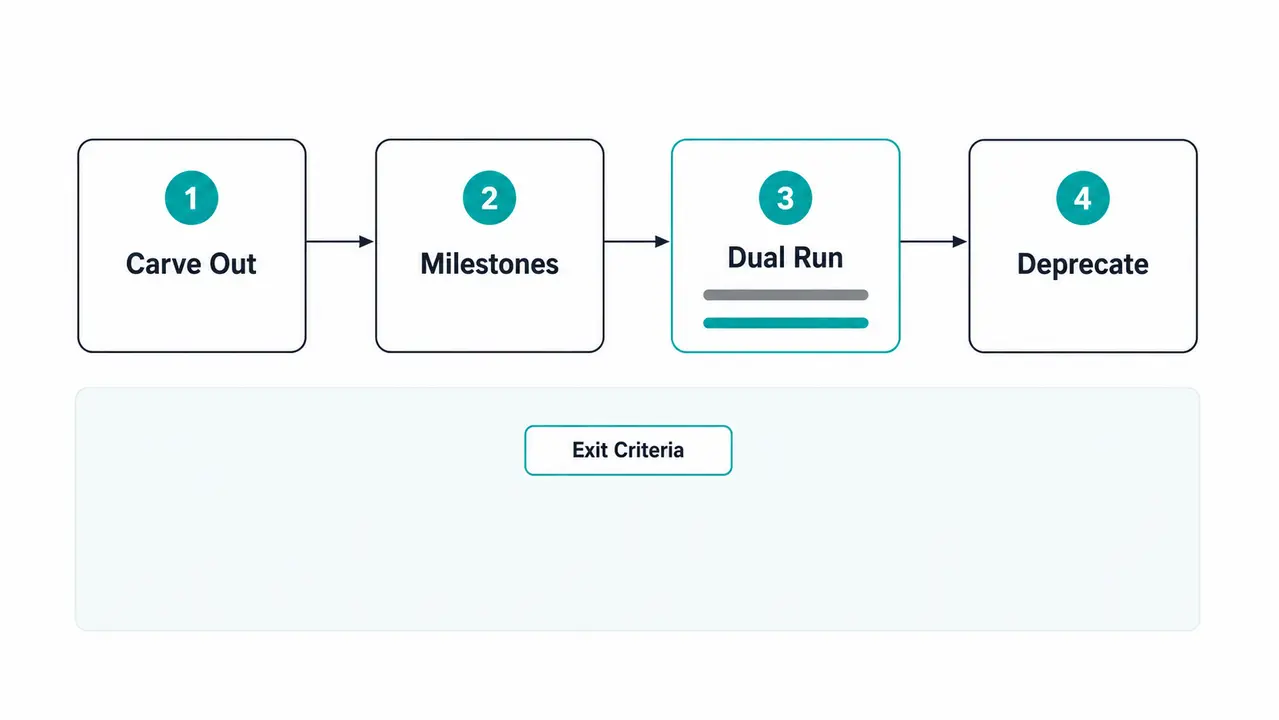
Expect at least one major platform transition and plan it as a formal program, not a side project someone runs between feature tickets. Splitting the monolith. Introducing eventing between services. Reworking identity and permissions. Multi-region readiness. These are second-system projects, and they fail when treated as background work.
Program mechanics are unglamorous and effective. Carve the transition out of the roadmap explicitly, so it competes with features openly instead of losing silently. Set migration milestones with measurable exit criteria. Run a dual-run strategy where old and new paths both serve traffic until the new one proves itself. Write a deprecation policy so the old path actually dies. Communicate to stakeholders on a fixed cadence, because silence breeds scope creep.
The counter-case matters. Premature complexity, event buses and multi-region for traffic that has not arrived, costs more than the monolith it replaces. Define the trigger metrics first. Scaling technology on real signals beats scaling it on projections.
What you can fix in a month
You can improve predictability in one month by tightening feedback loops, clarifying ownership, and removing the top operational blockers. Not a transformation. A focused sprint on the delivery system itself.
Week one, baseline the metrics. Lead time, change failure rate, deploy frequency. Map ownership, service by service, and pick one critical user journey to protect explicitly. Most teams discover the map is wrong within two days of writing it down.
Week two, attack the mechanics. CI reliability, review queue policies, a release checklist, incident hygiene. Week three and week four, test strategy where coverage matters most, a documentation sprint on the architecture overview and runbook, and a pilot of the embedded model on one domain. Measure lead time and change failure rate again and adjust. A growth stage company that runs this month well typically finds its constraint has moved from chaos to something nameable, which is the precondition for every improvement after it.
Frequently asked questions
What does development for scale-ups include beyond coding?
It includes the delivery system around the code. Ownership boundaries, CI and release discipline, onboarding artifacts, incident response, and the migration plans that make platform transitions survivable. Coding is maybe half the work. The other half is what lets ten engineers ship faster than three.
What should we standardize first if everything feels broken?
Start with the deploy path and the rollback procedure, because every other improvement depends on shipping safely. Then fix CI reliability and review queue policy. Standardizing anything else while deploys are manual and rollbacks are folklore just adds process on top of risk.
How do we onboard an external team into a complex codebase safely?
Give them the same access, rituals, and review rules as your internal team from day one, and scope their first month to one domain rather than the whole system. Pair them with your engineers on the first two or three changes. Require documentation contributions as part of the definition of done so the codebase gets clearer as they work.
When do AI coding tools help, and when do they hurt quality?
They help with well-understood, well-tested codebases where review gates catch mistakes, and with boilerplate, tests, and refactors of clear scope. They hurt when the codebase lacks tests, ownership is unclear, and review queues are already long, because generated code arrives faster than anyone can verify it. We use tools like Claude Code and Cursor internally, always inside the same review discipline.
How do we avoid dependency on an external team while still moving fast?
Write the knowledge transfer plan into the engagement before it starts. Pairing rotations, documentation expectations, and periodic rotation of who owns which component. Keep architectural decisions and product ownership on your side. Then the external team adds capacity rather than becoming infrastructure you cannot remove.
Choose the constraint you cannot afford to violate
Pick the single constraint your delivery model must protect, whether that is reliability, speed, security, or the ability to survive architectural change, and design everything around it. A team with a three-day review queue and a migration looming next quarter has already answered the question, even if nobody has said it out loud. Development for scale-ups, scaling technology, expansion support, whatever label you use, comes down to that one choice. Which constraint does your leadership team agree you cannot afford to violate?
About Sentice

Sentice is a boutique software engineering partner founded in 2013 by Roni Levi and Martin Petkovic, now headquartered in Skopje, North Macedonia. Rather than supplying individual developers, we build embedded teams that blend with a client’s culture, tech stack and goals, working together from a single office under our own technical leadership. We deliver dedicated software engineering teams, end-to-end software solutions, product development, and system and embedded engineering, and we act as technical advisors across the full development lifecycle, from specification and architecture through development, testing and support. We use AI coding tools across every project, and we help clients integrate AI into their own products through chatbots, MCP services, connected application layers and workflow automation. Some of the clients we started with more than a decade ago are still building with us today.