
Your roadmap has fourteen items. Your team has four engineers and one of them reviews every pull request. Somewhere around week six you notice that the bottleneck is not talent or budget. It is the absence of an operating system for how decisions get made, who owns what, and what “done” means. That is the real problem of software development for startups, and almost nobody budgets for it.
Reading time: 12 min
Key points
- The first scaling pain in startup engineering is coordination and decision rights, not headcount.
- Discovery is a technical discipline that should end with a milestone plan and a data model sketch, not sticky notes.
- Embedded teams win on ownership and product context where freelancers and staff augmentation scatter responsibility.
- A 30 day validation sprint tests a partner’s operating system under real conditions before you commit.
Table of contents
What software development for startups really means in practice
Software development for startups is product engineering under uncertainty. Early stage development is not a smaller version of enterprise delivery. The goal is rapid learning while keeping the codebase viable for whatever the company becomes next quarter.
In practice you run three tracks at once. Product learning tells you whether anyone wants the thing. Engineering quality keeps the codebase from collapsing under the next pivot. Delivery cadence turns both into shippable increments every week or two. Drop any one track and the other two stall.
The minimum artifact set is small and most teams skip it. A one page product brief, a lean spec per feature, architecture notes that record why decisions were made, and a written definition of done. Teams that manage these tracks deliberately through structured early stage product development avoid the classic failure mode. That failure mode is shipping features that cannot be operated, tested, or iterated without immediate breakdown.
The week a founder realizes the roadmap is bigger than the team
The first scaling pain is coordination, not headcount. A founder calls us because velocity dropped. The diagnosis is almost always the same. One senior engineer has become the bottleneck for code reviews, releases, and every architecture call. Nothing moves without that person, and that person is saturated.
Adding developers before fixing this makes it worse. New engineers generate more review load, more questions, and more rework, all routed through the same bottleneck. Velocity drops while headcount rises, and everyone blames onboarding.
The fix is an operating model with explicit decision rights. The tech lead owns architecture. The product owner owns scope. The delivery lead owns cadence. Write those three sentences down and enforce them.
Adding people without this operating model always increases coordination drag. We have watched teams double in size and ship less. The people were good. The model was missing.
Early stage development succeeds when discovery is treated as engineering
Discovery is a technical discipline, not a business workshop. Its job is to reduce technical and product risk by turning assumptions into testable decisions. The output is a build plan engineers can execute without guessing, not a stack of sticky notes.
A real discovery phase for early stage development produces specific artifacts. Scope boundaries, so nobody debates edges mid sprint. User flows for the critical path. A data model sketch. An integration map covering the third party systems you will touch. Non functional requirements, even rough ones. A milestone plan tied to demos, not documents. For an MVP sized scope this takes one to three weeks.
The failure mode is predictable. Sprint one becomes paid brainstorming. Three weeks later there is a beautiful FigJam board and zero shippable code. If discovery does not end with a milestone plan and a data model sketch, you did not run discovery. You ran a meeting series.
MVP planning that avoids a rewrite trap
An MVP is a learning vehicle, and learning vehicles need deliberate constraints to evolve. Build one end to end workflow with real authentication, real data persistence, and auditability on the core actions. Defer secondary roles, admin panels, and every “wouldn’t it be nice” that surfaced in the kickoff call.
Some things must be production grade from day one. Logging, error handling, a basic security posture, and a working deployment pipeline. These are not gold plating. They are the minimum that lets you observe real user behavior and iterate on it.
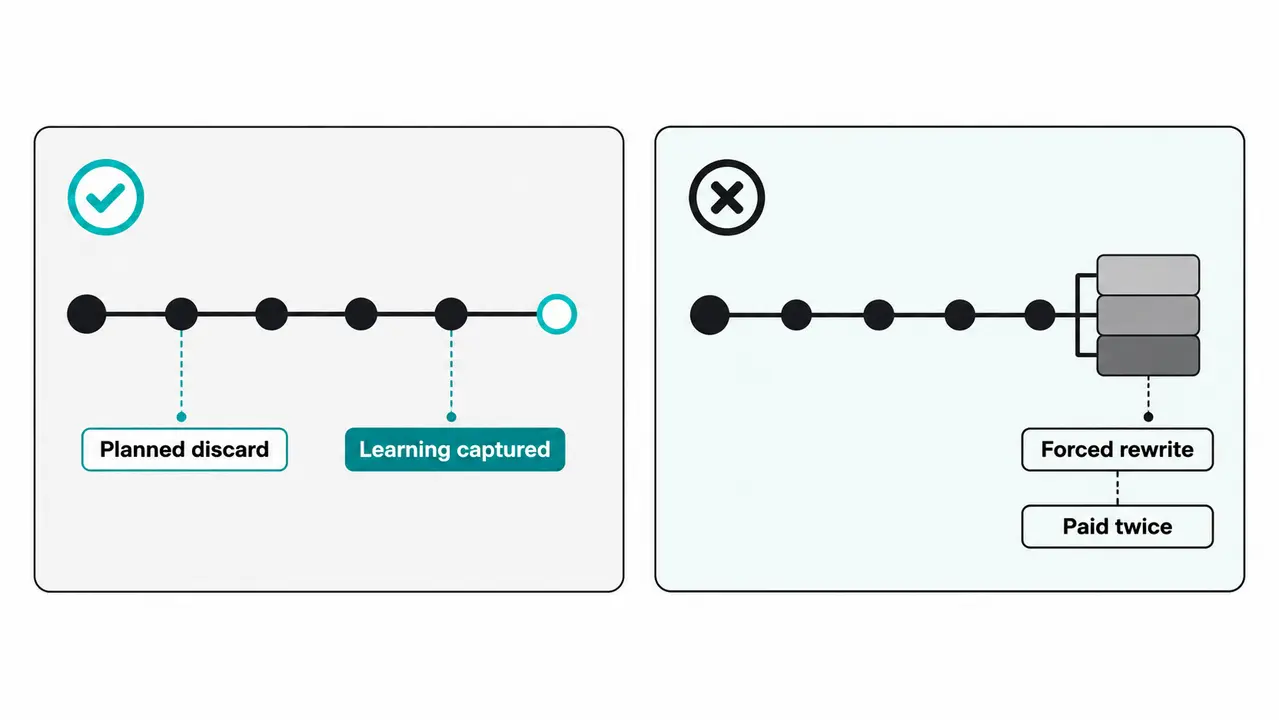
Here is the distinction that matters. Throwing away MVP code is normal. Good teams do it deliberately once the learning is captured. Rewriting MVP code because it lacks tests, logging, or a deployment path is a failure of engineering standards, not a pivot. The first is strategy. The second is a tax you pay twice.
Selecting custom code and off the shelf tools before writing code
Startups win by buying commodity capabilities and building only what creates differentiation. The decision should be made explicitly, before the first sprint, and revisited as the product matures.
The commodity list is stable across almost every product we build. Analytics, billing, transactional email, feature flags, auth providers, observability. Stripe, Postmark, LaunchDarkly, and their competitors exist so your engineers can spend those months on the thing customers actually pay for.
Use a rubric with five questions. Does this capability differentiate us? What is the switching cost if we change our mind? Does compliance force a specific approach? How complex is the integration? How fast do we need it to validate the hypothesis?
The verdict is simple. Always outsource commodity functions unless the function is the core product. Building an internal analytics tool before product market fit is the most common months-long detour we see.
Engagement models that startups use when hiring is not the answer
Startups choose between four models when hiring is not the answer, and the choice depends on how much product context and ownership you need. The table below compares them on the dimensions that actually decide the outcome.
| Model | Architecture owner | QA and DevOps | Ramp time | Main tradeoff |
|---|---|---|---|---|
| In-house hiring | Your CTO or tech lead | Internal | Months | Hiring and management overhead |
| Freelancers | Nobody by default | Not included | Days | No continuity or shared context |
| Staff augmentation | Your internal leads | Shared | Weeks | Needs strong internal leadership |
| Embedded team | Partner tech lead | Partner owned | Two to four weeks | Requires real integration into your workflow |
An embedded team is a cohesive unit that works inside your process. Dedicated software engineering teams own architecture, QA strategy, DevOps, and release management as a single accountable unit. The other models scatter those responsibilities, and the failure mode follows. Tickets get closed, nobody owns the outcome, and the product does not move.
Why in house hiring stalls when the roadmap is urgent
Hiring is a delivery strategy only when you can absorb ramp up time and management overhead. Most startups with an urgent roadmap cannot absorb either.
Count the hidden work before you post the role. Interview loops eat senior engineering hours for weeks. Onboarding takes a month before a new hire produces at full speed. Team formation takes longer, and management bandwidth is a real cost nobody puts in the budget. Someone has to set code standards, stand up the CI pipeline, define incident response, and build knowledge sharing rituals that did not exist before.
The pattern we see repeatedly is a six month feature stall while the internal team builds management and platform foundations. Necessary work, badly timed.
If you already have a strong technical leadership layer, hire. If you do not, in-house hiring is the weaker option for near term delivery, because you are hiring the people who will need the leadership you lack.
Freelancers move fast until the product needs continuity
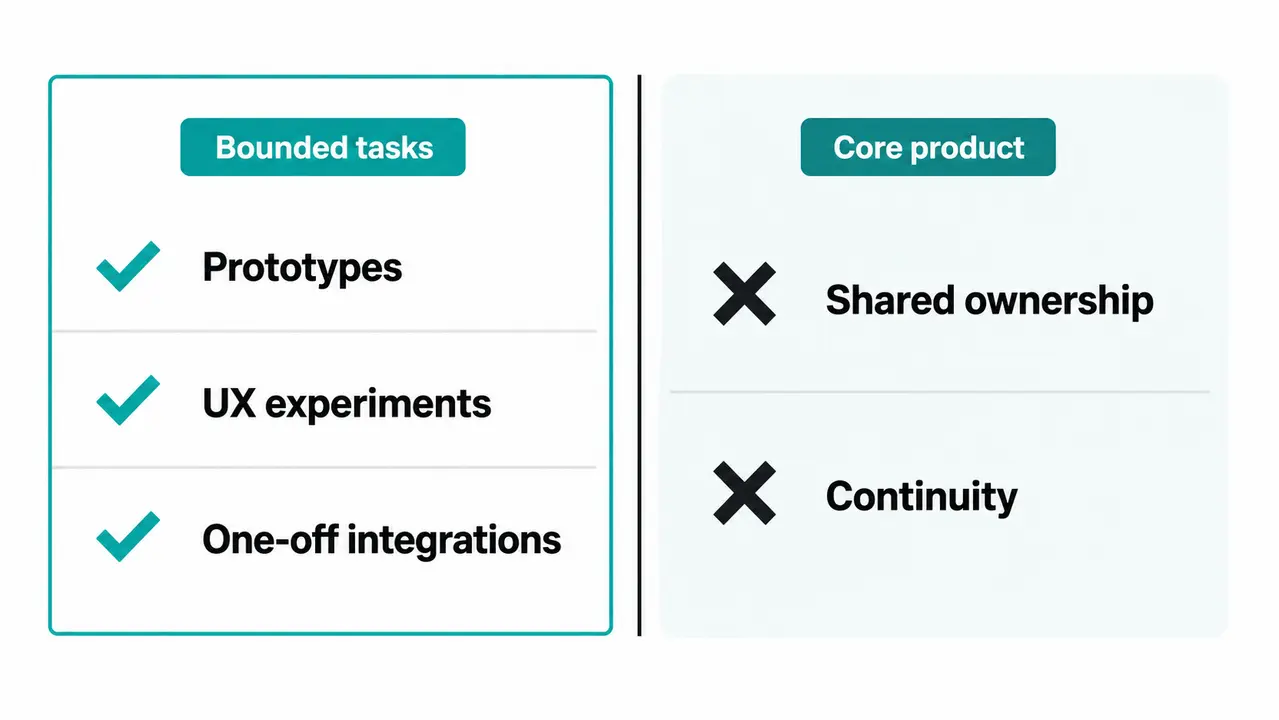
Freelancers are excellent for bounded tasks, technical spikes, and short bursts of focused work. They become risky the moment the product needs shared context, long term ownership, and coordinated delivery.
Here is the scenario that ends the experiment. One freelancer owns your billing subsystem. A production incident hits on a Friday. The freelancer is on another contract, unresponsive, and the only documentation is a Slack thread from two months ago. Your team reverse engineers a critical subsystem during an outage.
Freelancers fit cleanly in three situations. Prototypes with a hard deadline. UX experiments where the code is disposable. One off integrations with clear acceptance criteria and a defined end state.
Beyond the first narrow slice of core product, freelancers are a weaker option. A product assembled from disconnected contractors becomes a codebase no one fully understands, including the people billing to maintain it.
Staff augmentation works when your team already has strong technical leadership
Augmentation adds capacity, not direction. The model works when your internal leads can provide architecture, backlog clarity, code review discipline, and operational standards. The augmented engineers plug into an existing system.
Check the prerequisites honestly before signing. Clear repository standards. An active CI pipeline. Established sprint rituals that actually happen. An ownership map that says who is responsible for each service. Onboarding documentation that goes beyond a README.
If those exist, augmented engineers can produce within two weeks. If they do not, augmented engineers ship code that passes tickets and fails product outcomes. We have inherited codebases where every ticket was closed on time and the system could not be deployed without three days of manual ritual.
Staff augmentation is the weaker option when the startup is missing a strong internal lead layer. You are buying hands when the problem is a missing head.
Embedded engineering teams win on ownership and product context
An embedded team is a cohesive unit that integrates into your workflow and owns outcomes, not just tasks. The model reduces coordination overhead and preserves product knowledge over time, because the same people who learned your domain in month one are still there in month twelve.
The concrete anchors matter more than the label. Stable team composition, so knowledge does not walk out the door each quarter. Shared rituals, meaning your standups, your demo cadence, your tools. A tech lead accountable for architecture decisions. Documented decisions, so the reasoning survives the people.
A true startup tech partner goes further. Senior only teams, so you are not paying for someone’s learning curve. Fast onboarding measured in days. An advisory posture, meaning they tell you when your idea is wrong. End to end SDLC coverage from discovery through production operations.
When you need speed plus continuity and cannot afford delivery drift, this is the stronger option.
Evaluation criteria for a startup tech partner before you sign
Evaluate a partner across engineering depth, delivery governance, and the ability to operate as part of your company. References matter less than the partner’s working system and the transparency of their decision making.
Run a checklist before signing. Seniority mix of the proposed team. How involved their tech leadership will be, in writing. Code review policy. Testing strategy. Who owns DevOps. Security posture. Documentation habits, which you can verify by asking for samples.
Ask for three artifacts. A sample sprint report. An architecture decision record from a real project. An anonymized onboarding plan. A partner with a real operating system produces these in a day. A partner with a pitch deck produces them never.
The evaluation must test the operating system, not just coding ability. Anyone can pass a technical interview. Far fewer can run a delivery cadence that survives your worst quarter.
Founder support that keeps product decisions from turning into rework
A good partner helps founders translate goals into constraints, milestones, and tradeoffs that engineering can execute. Founder support shows up as structured decision making, not vague advice and agreement in meetings.
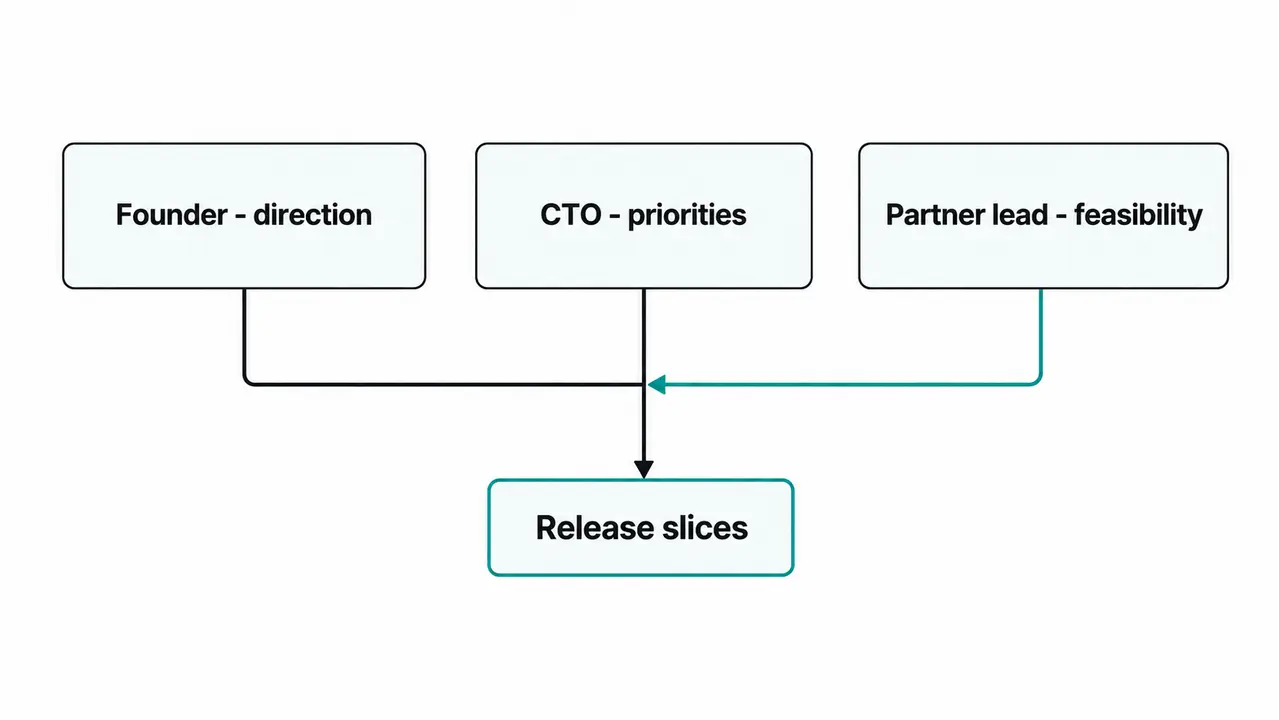
Concrete examples. Turning investor milestones into release slices that map to a demo cadence. Defining what “enterprise ready” actually means for version one, so the term stops being a scope bomb. Setting non functional requirements early, before they become expensive retrofit work.
The roles are clear. The founder CEO owns direction. The CTO or product lead owns priorities. The partner tech lead owns technical feasibility and tradeoffs, and is expected to push back.
The failure mode is scope churn that looks like agility but is actually indecision. Every pivot mid sprint is engineering rework, and rework compounds. A partner who agrees with every new idea is not supporting you. Guardrails, not applause.
A delivery system that technical leaders can trust
Trust comes from predictable cadence, visible quality signals, and fast feedback loops. A partner should run a delivery system that makes progress measurable without you micromanaging it.
The core mechanisms are unglamorous. Sprint planning with real capacity numbers. Demos of working software, not slide decks. Backlog hygiene, meaning stale items get killed. A definition of done that includes tests. A release checklist. An incident workflow that was written before the first incident.
The quality signals are the ones you can trend. Pull request review turnaround. Test coverage trend, not the absolute number. Escaped defect rate. Deployment frequency. Lead time for change.
A busy team with no shippable increments reaching production is the most expensive optical illusion in startup engineering. Trust is built on metrics and visibility. Verbal status updates are not evidence of anything except attendance.
Keeping quality high when speed is the business requirement
Startups can move fast and hold quality by standardizing a small set of practices that are never skipped. The goal is preventing compounding defects, because defects are what actually slow every future sprint.
The set is short. Automated tests for critical paths, not everything. Linting and formatting enforced by the pipeline, not by review comments. Code review rules with a time bound. A branching strategy everyone follows. Scheduled dependency updates. Security basics like secret scanning from day one.
Watch what a two day review queue does. Work in progress piles up, context switching multiplies, and engineers start new work to stay busy while finished work rots. The queue itself becomes a source of defects.
Quality gates are enablers of speed, not obstacles to it. Teams that treat them as overhead pay the debt with interest after launch, usually at the exact moment growth pressure is highest.
Security and IP hygiene that belongs in early stage development
Basic security and IP controls belong in early stage development from the first production deployment, not from the first enterprise deal. The work is mostly process and access discipline, not a compliance program.
The list is practical. Least privilege access to production. Secrets management instead of credentials in config files. Audit logs on sensitive actions. Dependency scanning in the pipeline. A secure SDLC checklist that references the OWASP Top 10 security risks as its baseline. On the IP side, assignment clauses in every contract, clear repository ownership, and an offboarding checklist that revokes access the day someone leaves.
For teams that want a structured path, the NIST Secure Software Development Framework describes how to integrate security practices into the pipeline itself rather than bolting them on afterward.
The failure modes are credential sprawl, lost source code ownership, and preventable breaches that stall enterprise sales cycles during security review.
Onboarding an external team without losing a month
Onboarding is a system. Access, context, and decision history, delivered in a repeatable way. The fastest onboarding happens when the startup prepares a small set of high leverage materials before day one.
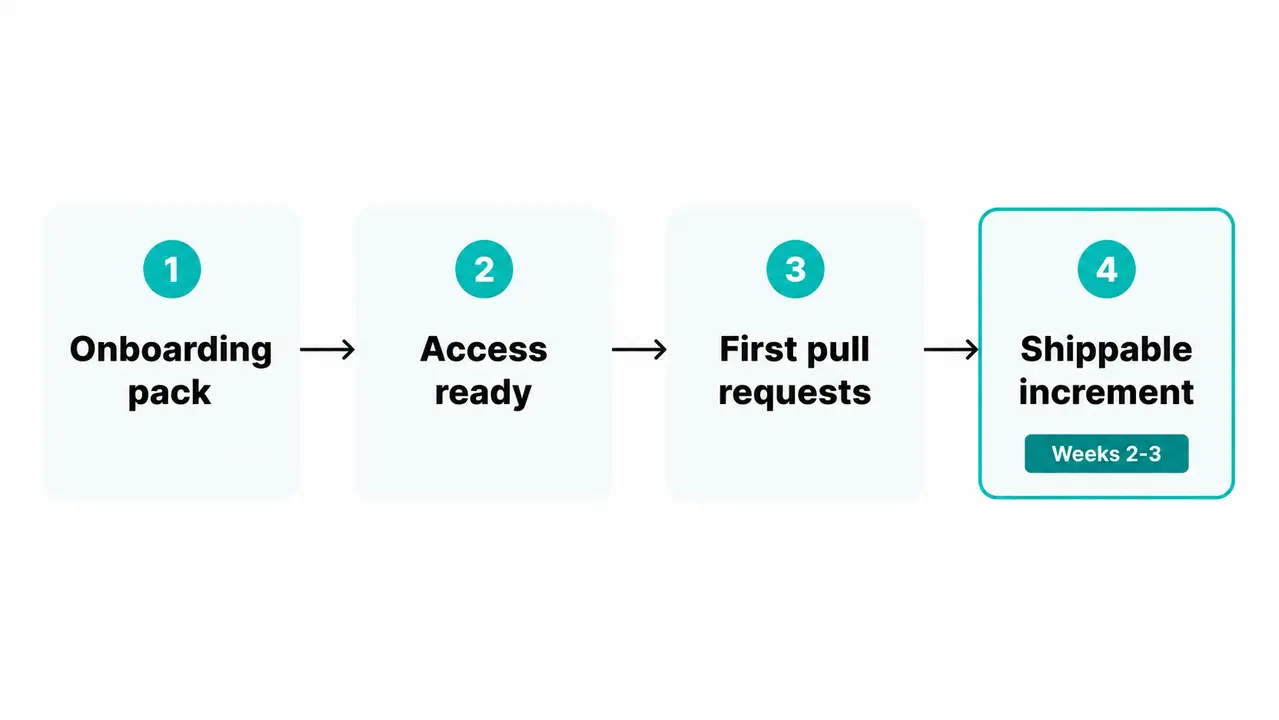
The onboarding pack has eight items. An architecture overview. Environment setup instructions that actually work. Runbooks for anything already in production. The top user journeys. Known risks, written down honestly. The roadmap. Your definition of done. Coding standards, even if they are three paragraphs.
With that pack, expect first meaningful pull requests in week one and a first shippable increment in weeks two to three on an existing codebase. Without it, the external team waits on answers, the founders become the bottleneck, and the month you budgeted for momentum becomes a month of clarification calls.
If you are weighing team expansion paths more broadly, our piece on scaling smart a strategic guide in house expansion outsourcing partnerships covers the structural tradeoffs in depth.
A 30 day plan to validate a development partnership
Treat the first month as a structured evaluation with deliverables and exit criteria. You are testing the partner’s operating system under real conditions, not their ability to write code for four weeks.
Week one covers a discovery refresh, environment readiness, and the first small pull requests. Small on purpose, so review turnaround and communication quality become visible early. Week two delivers one end to end slice, a demo, and a quality baseline with coverage and pipeline status. Week three covers hardening, monitoring, and the release pipeline, so the slice can actually reach production. Week four produces the roadmap plan, a risk register, and a staffing plan for the next quarter.
At day 30 you should be holding a working increment and a written plan. Anything less means the operating system does not exist. The 30 day plan is a trial run of the delivery system, not a one off project, and it should be judged as one.
Test a delivery system, not a pitch
Run the first 30 days as a structured validation with exit criteria, and judge the operating system on evidence.
Frequently asked questions
What should I prepare before talking to a development partner?
Prepare a one page product brief, a description of your target users, the top three workflows the product must support, your constraints around timeline and technology, and what success looks like in 90 days. You do not need a full specification. You need enough for a partner to ask sharp questions instead of generic ones.
How do I know if I need a tech lead or a full team?
If architecture and delivery decisions are bottlenecked on one person, start with leadership coverage before adding execution capacity. A senior tech lead can unblock decisions, set standards, and run discovery while you validate whether a full team is justified. Adding engineers before the leadership layer exists just multiplies the queue.
What deliverables should I expect after discovery?
Expect scope boundaries, a milestone plan, an architecture outline, a prioritized backlog, and a release plan that includes environments and observability. If the discovery output cannot be handed to engineers and executed without a follow up workshop, it was not discovery.
How do I keep control of technical decisions with an external team?
Set decision rights in writing before the engagement starts, require written decision records for major architectural calls, and run regular architecture reviews with your internal owner present. Control comes from participation in the decision process, not from approving every ticket.
When is it too early to set up DevOps and continuous integration?
Once you have a production environment, it is not too early. Continuous integration must exist before the first release, not after the first incident. Global digital progress and infrastructure trends show that the underlying cloud and connectivity foundations supporting these pipelines keep maturing, which removes the last technical excuse for delaying them.
What happens to the code and documentation if the engagement ends?
The repository, infrastructure configuration, and documentation should be yours from day one, hosted in accounts you control. Insist on this in the contract. A clean exit requires that decision history, runbooks, and environment setup live in your systems, not in the partner’s internal wiki.
The line between velocity and chaos
Building a startup means engineering under extreme uncertainty, where the architecture must survive the next pivot without collapsing. You can buy speed through fragmented freelancers, or you can buy continuity through an embedded team that owns outcomes end to end. Map your current bottleneck, define your operating model, and start a 30 day validation sprint before you commit to either. Will your current delivery system survive the next three months of roadmap pressure?
About Sentice

Sentice is a boutique software engineering partner founded in 2013 by Roni Levi and Martin Petkovic, now headquartered in Skopje, North Macedonia. Rather than supplying individual developers, we build embedded teams that blend with a client’s culture, tech stack and goals, working together from a single office under our own technical leadership. We deliver dedicated software engineering teams, end-to-end software solutions, product development, and system and embedded engineering, and we act as technical advisors across the full development lifecycle, from specification and architecture through development, testing and support. We use AI coding tools across every project, and we help clients integrate AI into their own products through chatbots, MCP services, connected application layers and workflow automation. Some of the clients we started with more than a decade ago are still building with us today.